
Women you should know
Office of the Dean
April 20, 2016
In honor of Women's History month, six UC Irvine faculty recognize the trailblazers and activists whose names and lives we should know
The UCI School of Humanities has been home to countless trailblazers. This past year alone has seen several of our own recognized for their contributions to the world. Vicki Ruiz, Distinguished Professor of history and chair of Chicano/Latino studies, was the first UCI faculty member to receive the National Humanities Medal from President Obama; Ruth Kluger, professor emerita of German, recently keynoted Germany’s holocaust remembrance, an honor she shares with Elie Wiesel; Linda Vo, professor of Asian American studies, was listed on the OC Register’s “Most Influential” list; and, in May, Julia Lupton, professor of English, will receive UCI’s “Outstanding Faculty Achievement” award.
In honor of Women’s History Month, six UCI School of Humanities faculty members, who actively write about women trailblazers and activists, have nominated women whose stories broaden and deepen our understanding of history.
In discussing why Women’s History Month matters, the National Women’s History Project writes, “History helps us learn who we are, but when we don’t know our own history, our power and dreams are immediately diminished. Recognizing the achievements of women in all facets of life – science, community, government, literature, art, sports, medicine – has a huge impact on the development of self-respect and new opportunities for girls and young women.”
Below, we list the names and stories of women we should know, as nominated by UCI School of Humanities faculty members Christine Bacareza Balance, Sharon Block, Jessica Millward, Vicki Lynn Ruiz, Jeanne Scheper and Judy Wu.
Charity Folks: Her story expands the narrative of slavery
“Our knowledge of the enslaved tends to be male-dominated and focused on those who have fled bondage, such as Frederick Douglass, or those who have plotted rebellions, such as Nat Turner. Charity Folks’ story gives us new insight into the world of enslaved women, taking us through the range of lived experiences – from reproduction to motherhood, experiences with power and legal culture, from bondage to freedom, and what life can look like after slavery.”
Nominated by Jessica Millward, associate professor in the Department of History. Millward is the author of Finding Charity’s Folk: Enslaved & Free Black Women in Maryland (University of Georgia Press, 2015), a social history uncovering the life and genealogy of Charity Folks.
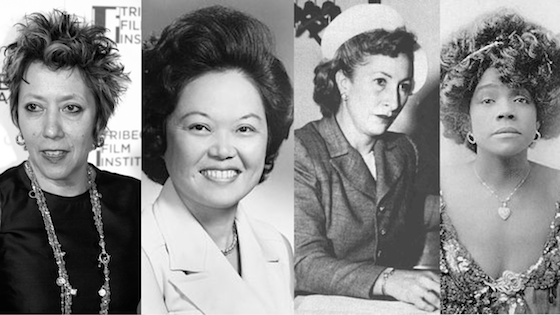
Jessica Hagedorn: Asian American writer, performer, and playwright
Jessica Tarahata Hagedorn is a canonical Asian American writer, performer, and playwright. Born in the Philippines in 1949, she immigrated to U.S. in the late 1960s and was mentored by Kenneth Rexroth, the poet who gave the “Beat” writers their name. He edited and published her first poems in the 1973 collection, Four Women. Trained at the American Conservatory Theatre (ACT) and informally schooled by attending rock and funk concerts, Hagedorn also led her “poet’s band,” The Gangster Choir, in its San Francisco (1975-1977) and New York (1980-1985) iterations. The band featured respected musicians including Julian Priester, Bugsy Moore, Linda Tillery, and Vernon Reid. During this time, as a writer/performer, she also collaborated in performance with the famed Chicago Art Ensemble. With her “satin sisters,” Thulani Davis and Ntozake Shange, Hagedorn moved to New York in the late 1970s and collaborated on their theatre piece, “Where the Mississippi Meets the Amazon,” which was produced by Joseph Papp and the Public Theatre in 1977. A staple amongst the 1980s downtown New York performance scene, since that time, Hagedorn has also performed and collaborated with Laurie Carlos and Robbie McCauley, as Thought Music, in Teenytown (1988), as well as Han Ong in Airport Music (1993). She is most well-known for her novels including the classic Dogeaters (1990), which was later adapted into a play that has been produced in New York, Los Angeles, San Francisco, and Manila; Gangster of Love (1996); Dream Jungle (2003); and Toxicology (2011).
Nominated by Christine Bacareza Balance, associate professor in the Department of Asian American Studies. She assisted Jessica Hagedorn in editing the Asian American literary collection, Charlie Chan is Dead 2: At Home in the World (2004), and her forthcoming book Tropical Renditions: Making Musical Scenes in Filipino America (April 2016) features a chapter on Hagedorn’s years with the Gangster Choir.
Judith: Fought for her freedom
“Very few people would have heard about a colonial Virginia woman named Judith. For thirty-plus years, she was forced to live as a slave to several elite Anglo-American men. But on the first Saturday of May 1773, she liberated herself, running away from the British merchant to whom she had been sold the day before. Judith escaped carrying her one year-old still-nursing baby, and was likely pregnant. Perhaps knowing that her children would be forced into slavery encouraged her to make the dangerous decision to escape enslavement. Records suggest that a woman matching her description would join the British army during the American Revolution and work as a laundress, thus legally securing her and her children’s freedom. Judith should be remembered during women’s history month as a representative of the thousands and thousands of unrecognized women who fought for basic rights in their daily lives, and who figured out ways to survive the many abuses that resulted from America’s intertwined histories of racism and sexism.
For the advertisement offering a reward for Judith’s return to slavery, see The Virginia Gazette May 6, 1773. For an insightful and moving discussion of women escaping southern slavery, see Stephanie Camp, Closer to Freedom: Enslaved Women and Everyday Resistance in the Plantation South (UNC Press, 2004).”
Nominated by Sharon Block, professor in the Department of History. Block is the author of Rape and Sexual Power in Early America (UNC Press, 2006); co-editor of Major Problems in American Women's History (Cengage, 2013), and author of the forthcoming Colonial Complexions: Race and Bodies in Colonial America (UPenn Press).
Patsy Mink: Trailblazer in educational equity
“I nominate Patsy Takemoto Mink, the first woman of color U.S. Congressional representative. Many people tend to think that Shirley Chisholm was the first woman of color, but she was the first African American. Patsy Mink was a third generation Japanese American from Hawaii. She was in Congress for 1965-1976 and again from 1990-2002. Mink is perhaps best known for co-sponsoring and defending Title IX, which was renamed the Patsy Mink Equal Opportunity in Education Act when she passed away in 2002. As you no doubt know, Title IX has transformed women’s educational opportunities by mandating gender equity in federally funded educational institutions. Title IX is most commonly associated with sports, but it really impacts all levels of schools, including admissions, scholarship, and so on. Mink also was a key advocate for other feminist initiatives, such as advocating for federally funded early child care education, the Women’s Educational Equity, and supporting the National Women’s Conference in Houston. She also was a keen advocate of civil rights, anti-war politics, and environmentalism.
Nominated by Judy Wu, professor in the Department of Asian American Studies. Wu is currently working with Mink’s daughter, political scientist Gwendolyn Mink, on a political biography of Patsy Mink.
Luisa Moreno: Champion of civil rights for Spanish-speaking workers in the U.S.
“Luisa Moreno was ‘una mujer sin fronteras’—a woman without borders. She was one of the most prominent women labor leaders in the United States. From 1930 to 1947, she mobilized seamstresses in New York’s East Harlem, cigar rollers in Florida, and cannery women in California. The first Latina to hold a national union office, she served as vice-president of the CIO cannery union (UCAPAWA). She was also the driving force behind the 1939 El Congreso de Pueblo de Habla Española, first national U.S. Latino civil rights conference. Moreover, as a Latina flapper during the 1920s, she published poetry and consorted with the likes of Diego Rivera in Mexico City before journeying to the United States.”
Nominated by Vicki L. Ruiz, Distinguished Professor of history and chair of Chicano/Latino studies. Ruiz pioneered the field of Chicana/Latina history and edited the seminal Latinas in the United States: A Historical Encyclopedia. She is currently working on a biography of Luisa Moreno.
Aida Overton Walker: African American performer & activist
“Aida Overton Walker (1880-1914) African American vaudeville performer. Overton Walker was a celebrated star of the early twentieth century transatlantic popular stage and a central figure in what James Weldon Johnson calls the “middle period” for African American theatre in the US, a time of resistance to minstrel forms and a period of growth and development of African American cultural production, writing, black theater management, and performance. Overton Walker was an innovator in this scene, a originator of the American genre of art-dance, a developer of modern dance, and a teacher-mentor who sought to better working conditions and expand roles for black women on the stage. Photographs of Walker show a self-possessed international star seated at the threshold between the Victorian and the modern. Overton Walker’s name was once considered a ‘household word’ in the US. When she died at the age of thirty-four in New York City in 1914, her funeral was considered “the largest ever held for a woman of the race,” and obituaries proclaimed her ‘The Dancer That Dignified the Profession.’
As a public thinker, Overton Walker’s performances on stage were augmented by the cultural critiques of racism and discrimination she offered in newspaper editorials. She drew attention to the way Jim Crow and racism in the US demanded particular embodiments of the black body—ways of moving and not moving, spaces to occupy and not occupy—and authorized which tropes were naturalized as ‘proper’ to black bodies. Race, she understood, is constructed at the level of the body and geography; power demands that bodies perform according to certain social scripts, whether these are registered directly in and as rules, codes, and laws that enforce racial segregation, or in and as performative repertoires of expectations, social blueprints, cultural practices, and so forth that regulate social identities. As Overton Walker describes in her editorials, these compulsory performances, on stage and off, were ubiquitous and relentless, and she directly addressed and protested them through her performances. Bringing the effects of racial power into view by responding to the injustice of these cultural mandates, she also articulated the added labor of critique required of black women as performers and as social actors moving through the public sphere.”
Nominated by Jeanne Scheper, assistant professor in the Department of Gender & Sexuality Studies. Scheper’s book, Moving Performances: Divas, Iconicity, and Remembering the Modern Stage, is forthcoming from Rutgers University Press in 2016.
We thank our humanities faculty for actively writing women back into history and bringing their stories and voices to life in their scholarship.
Pictured from left to right: Jessica Tarahata Hagedorn, Patsy Mink, Luisa Moreno and Aida Overton Walker